Dealership CSI Scores: How to Improve Them (2026)
Learn how to improve CSI scores at your dealership with data-backed strategies: better call handling, updates, first-time fixes, and AI tools.

Customer Satisfaction Index (CSI) scores can make or break your dealership’s bottom line. We’re not talking about motivational speeches or “ask for 10s” reminders. We’re talking about real money: hundreds of thousands in OEM incentive payouts, customer loyalty that compounds over years, and the operational chaos that drives scores down every single day.
If you’re reading this, you’re probably dealing with at least one of these problems:
- Losing OEM money tied to CSI tiers (co-op funds, bonuses, allocation advantages)
- Getting surprise bad surveys even when customers “seemed fine”
- Daily chaos killing your scores: unanswered calls, long holds, vague promises, zero updates
- No systematic approach to make great experiences repeatable
This guide is for Fixed Ops Directors, Service Managers, BDC Managers, Dealer Principals, and GMs who want a real system, not surface-level tips. You’ll get data-backed strategies, tactical playbooks with actual templates, and a 90-day plan you can implement starting Monday.
What Is CSI and Why Does It Matter for Your Dealership?
How CSI Differs from Google Reviews and NPS Scores
In most franchises, “CSI” means the manufacturer’s Customer Satisfaction Index derived from surveys the OEM sends customers after a service visit (and often after a sale). The exact questions vary by brand, but the pattern is consistent: the OEM collects responses, turns them into an index, and publishes performance reports by rooftop and department.
What CSI is NOT:
- Not your Google reviews or DealerRater ratings (those matter for lead flow, but don’t directly change OEM CSI)
- Not the same as NPS (Net Promoter Score) which is often a single recommendation question
CSI is usually a multi-question index measured on a 0-100 or sometimes 1000-point scale.
Why Top-Box Scoring Makes CSI So Hard to Improve
Here’s why dealership managers complain about CSI: many systems treat anything less than perfect as bad. A customer who marks 9 out of 10 can still hurt your score because manufacturers often count only “completely satisfied” responses. This is why customers get “the survey talk” about giving all top marks.
But here’s the critical mindset shift:
You can’t build a durable CSI program by trying to “win the survey.” You win by making it hard for customers to experience friction, confusion, or broken promises in the first place.
How Much Money Do Dealerships Lose with Low CSI Scores?
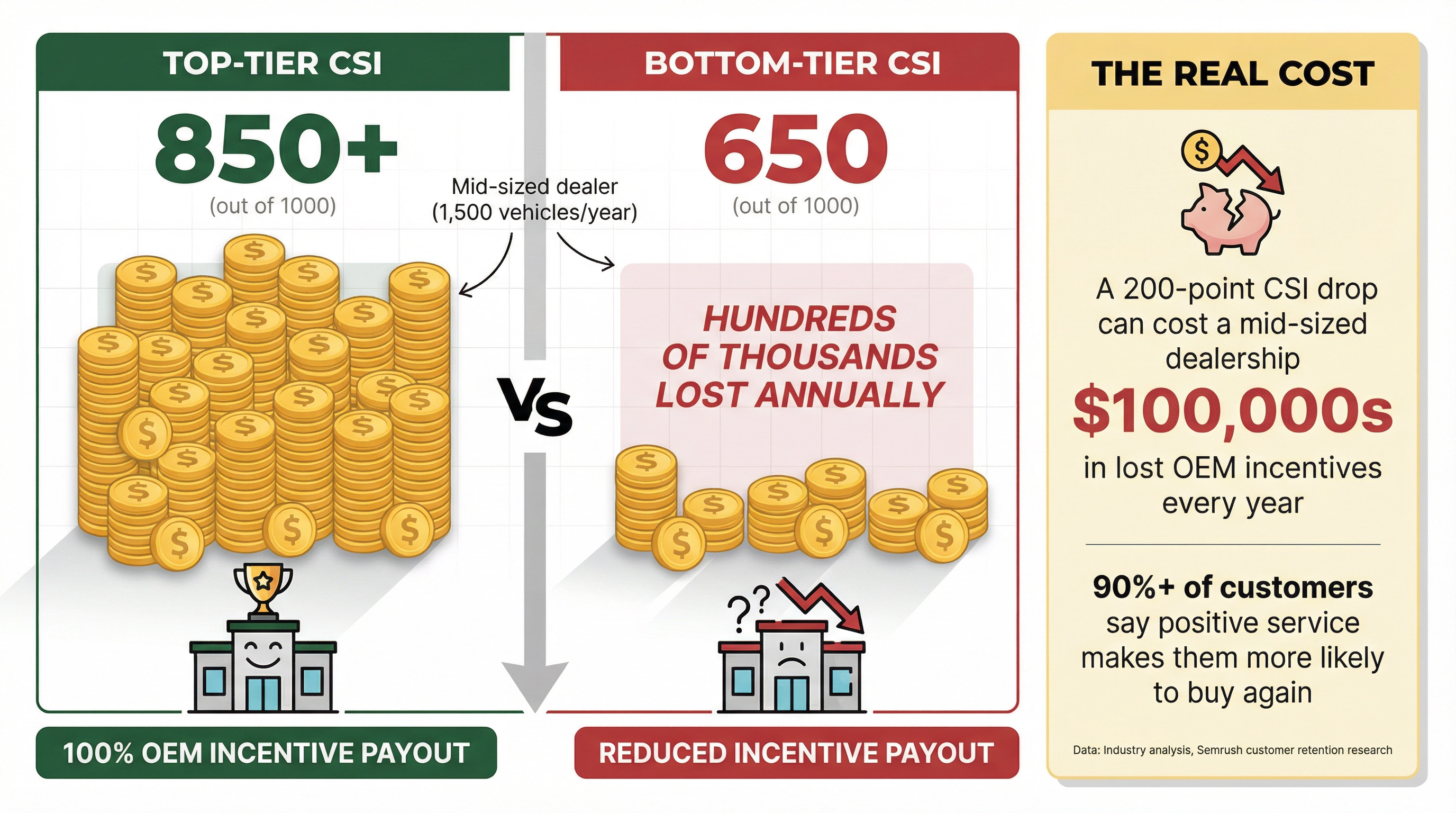
Top-tier CSI dealerships may receive 100% of available OEM incentive payouts, while mid-to-low performers leave massive money on the table. One analysis showed a mid-sized dealership selling around 1,500 vehicles yearly could lose hundreds of thousands of dollars annually in incentives if CSI falls from top to bottom tier.
Plus, over 90% of consumers say positive customer service makes them more likely to buy again. High CSI means customers who return, spend more over time, and refer others.
What Really Drives CSI: Friction and Trust
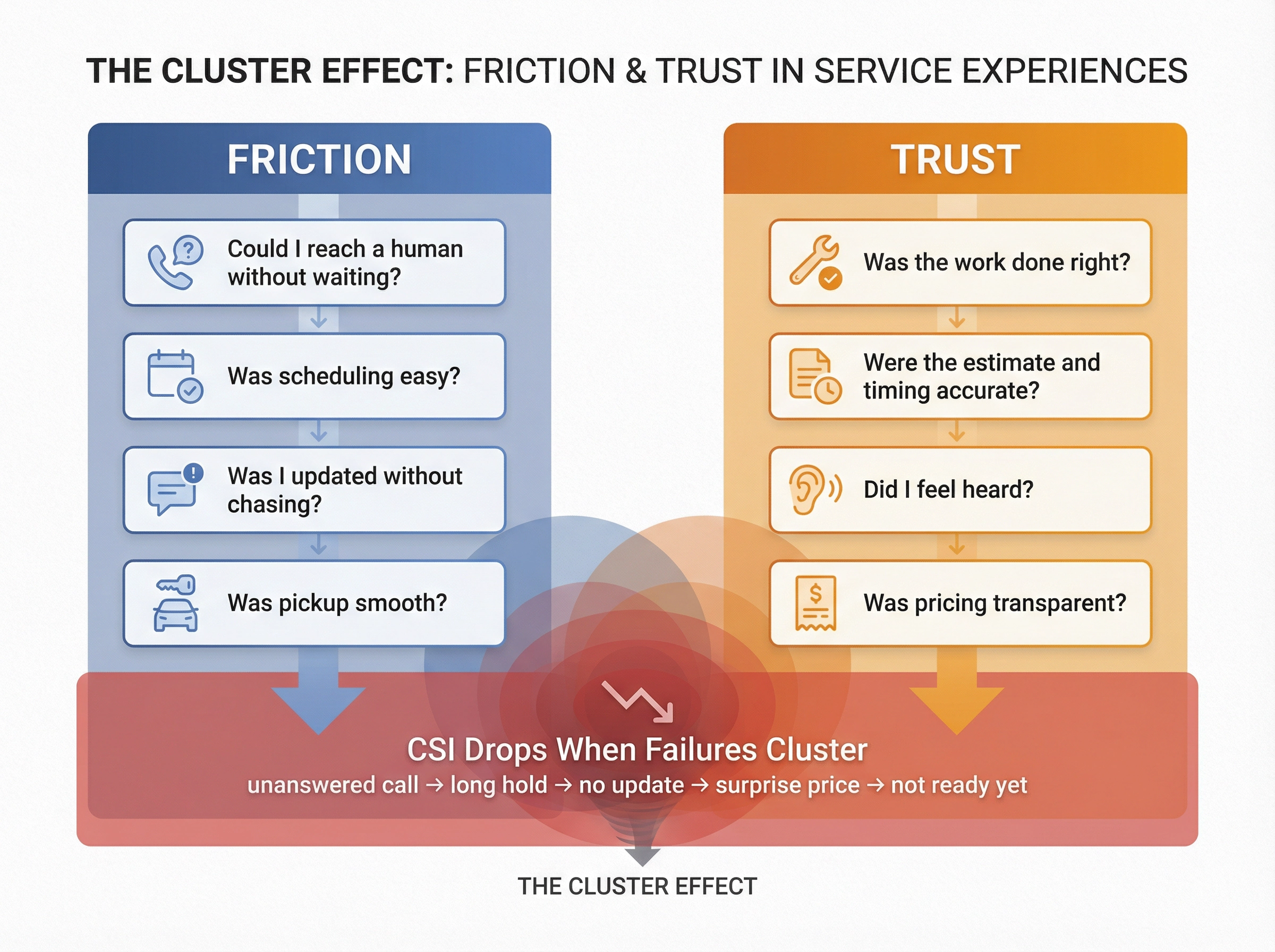
Almost every CSI question measures one of two things:
How Customer Friction Hurts Your CSI
Examples:
- Could I reach a human without waiting?
- Was scheduling easy?
- Was I updated without chasing?
- Was pickup smooth?
Why Trust Failures Show Up in CSI Surveys
Examples:
- Was the work done right?
- Were the estimate and timing accurate?
- Did I feel heard?
- Was pricing transparent?
CSI drops when friction and trust failures cluster. Customers can forgive one small miss if everything else is solid. They rarely forgive a chain: unanswered call, long hold, no update, surprise price, “not ready yet.”
So the real question becomes:
Where is your dealership creating friction or breaking trust often enough that it shows up in surveys?
What Factors Impact CSI Scores Most?
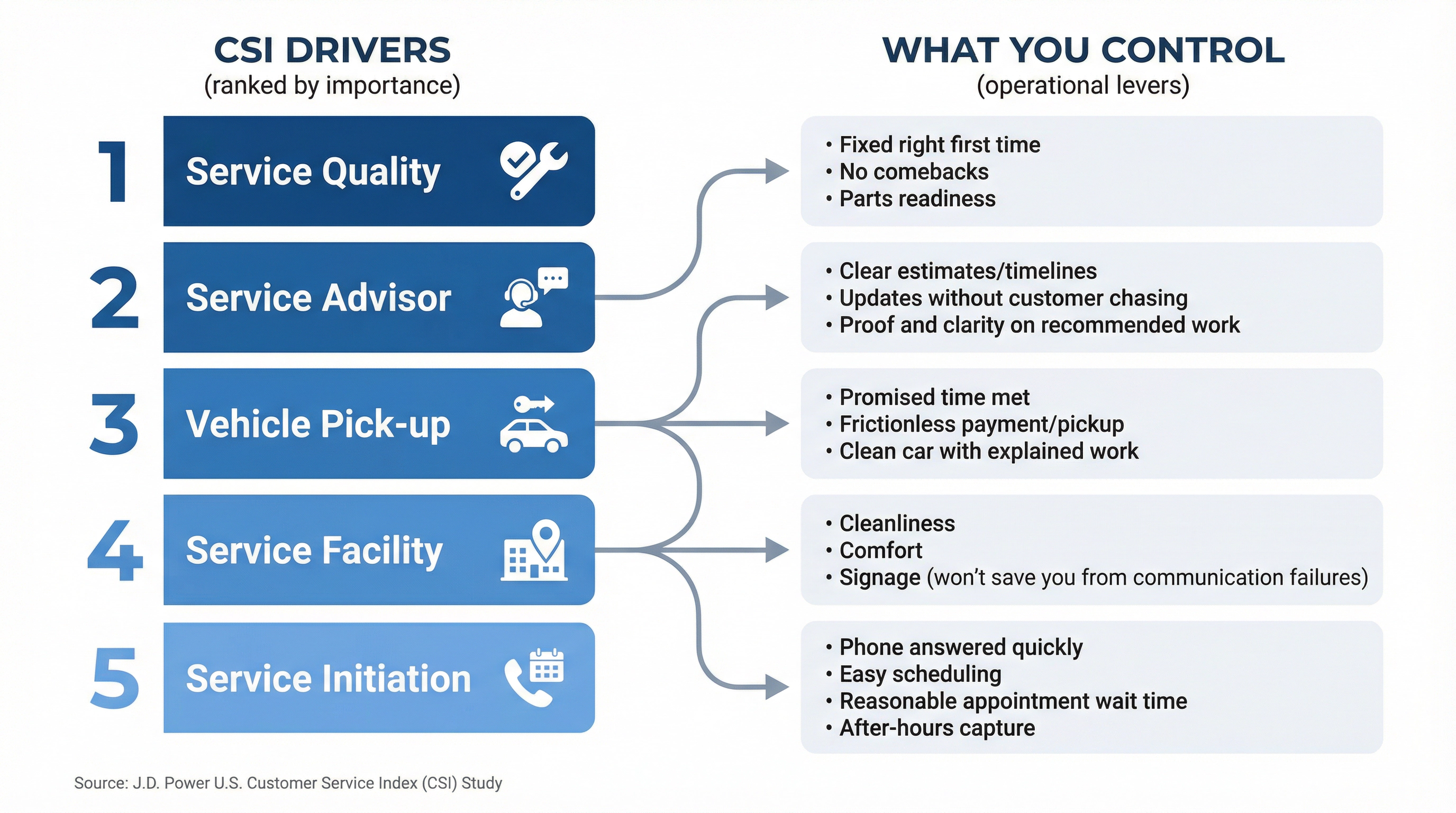
J.D. Power’s service satisfaction model breaks the service experience into five measures (in order of importance):
- Service quality
- Service advisor
- Vehicle pick-up
- Service facility
- Service initiation
Even if your OEM’s survey differs, these categories map cleanly to what customers actually feel. Here’s how to translate that into operational levers you can manage:
| Driver | What You Control |
|---|---|
| Service initiation (access) | Phone answered quickly, easy scheduling, reasonable appointment wait time, after-hours capture |
| Service advisor (communication) | Clear estimates/timelines, updates without customer chasing, proof and clarity on recommended work |
| Service quality (trust) | Fixed right first time, no comebacks, parts readiness |
| Vehicle pick-up (finish strong) | Promised time met, frictionless payment/pickup, clean car with explained work |
| Facility (baseline) | Cleanliness, comfort, signage (but won't save you from communication failures) |
How to Stop Losing CSI Before Customers Even Arrive

Why Call Handling Is Your Highest CSI Opportunity
A huge percentage of dissatisfaction starts before the visit, when customers try to reach you.
CDK’s 2025 Friction Points study found that 40% of service customers experienced call-center friction (hold, phone menu, transfers, had to call back, or no answer).
And it drags the whole experience score down:
- If no one answered, NPS was 26.7
- If customers were put on hold, they waited over 8 minutes on average and reported NPS 39.7
- The overall service NPS average in the same dataset was 59
This is why call handling is CSI-critical: you’re burning trust before the customer even meets your staff.
What Good Call Handling Looks Like in 2026
Pied Piper’s 2025 Service Telephone Effectiveness Study measured real dealer phone interactions:
- Hold time over 2 minutes occurred only 2% of the time in 2025 (down from 13% in 2024)
- “Mission failure” (customer hung up without being offered an appointment) was 9% in 2025 (down from 13% in 2024)
- Dealers using a service call center reached an associate in 51 seconds, vs 2 minutes 51 seconds when callers reached the dealership directly
That last number is basically a blueprint: you want consistent, fast pickup behavior, not “hope the advisor can grab it.”
How Long Will Customers Wait on Hold?
According to research on customer hold tolerance:
- 60% of customers hang up after just one minute on hold
- 32% aren’t willing to wait at all
- 63% prefer a callback rather than staying on hold
And about 1 in 3 callers never connect with a qualified agent, meaning millions in lost service appointments and sales.
How to Eliminate Hold Times and Unanswered Calls
Set up these rules storewide:
① Define a Service-Level Target
Example targets you can actually manage:
- 80%+ of calls answered in under 60 seconds (or stricter if you can)
- Hold longer than 2 minutes should be rare and measured
If you don’t track this, you’re guessing.
② Stop Using Advisors as the Primary Phone System
Advisors are there to build trust in the lane. When they’re stuck in phone interruptions, both sides suffer: the caller waits, and the in-store customer gets a distracted advisor.
③ Offer a Real “Escape Hatch” If the Customer Is Waiting
- If you can’t answer quickly: offer callback scheduling immediately (not voicemail)
- If you can’t schedule immediately: book a slot for a human callback with context already captured
④ Treat After-Hours as Real Demand, Not a Voicemail Graveyard
After-hours calls are often your easiest CSI win because the bar is so low in the industry. Industry research shows 56-60% of dealership leads arrive after business hours, and around 70% of people who hit voicemail call a competitor within 30 minutes.
If your store is closed and you force voicemail, you’re training customers that your dealership is hard to deal with.
Peak times matter too: Monday 10 AM to 12 PM are the highest call traffic windows. Dealers lose the most business when staffing can’t keep up with Monday morning spikes.
How AI Can Solve the Access Problem
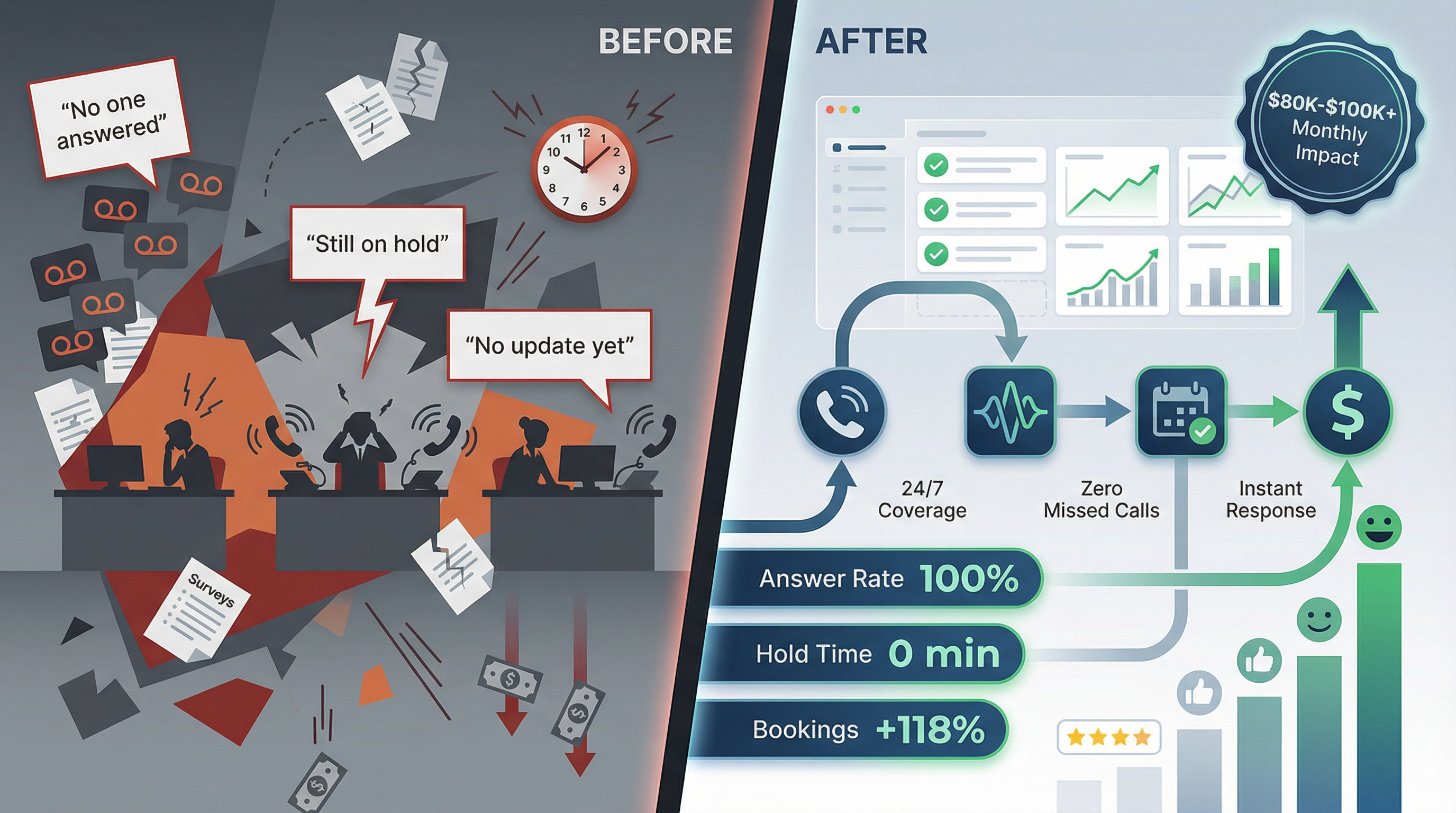
This is where AI-powered call handling changes everything. Modern AI communications platforms can answer every call instantly, 24/7, with natural voice agents that sound human. No holds. No voicemail. No missed opportunities.
The best solutions integrate directly with your scheduler and DMS to book appointments in real time, not just take messages. Dealerships using this approach report zero missed calls, zero hold times, and monthly profit impacts of $80,000 to $100,000+.
For stores that need multilingual support, AI voice agents can handle conversations in any language, which is critical for reaching the roughly 21 million Hispanics in the U.S. who have difficulty speaking English fluently.
How to Reduce Appointment Wait Times and Improve CSI
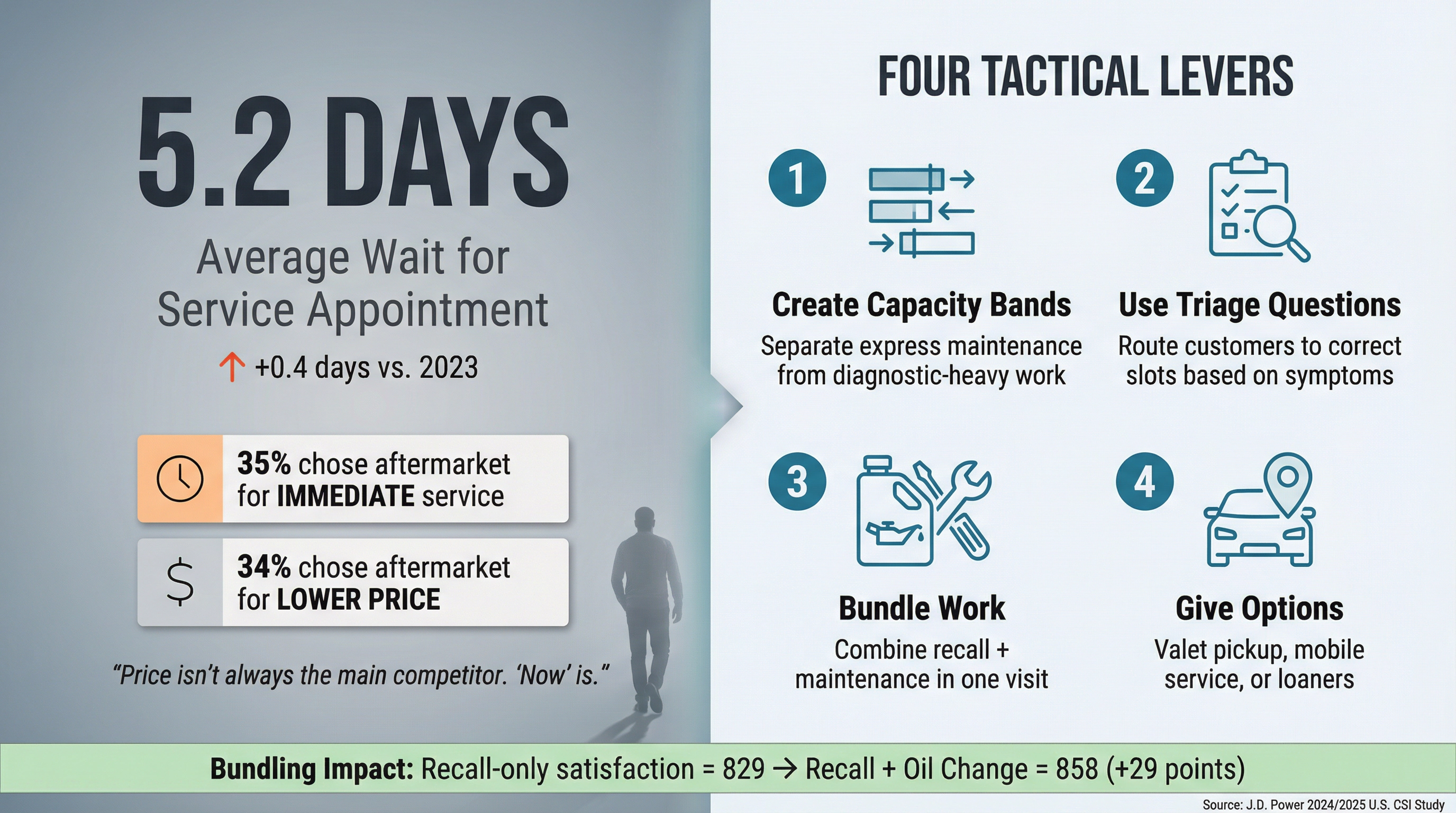
J.D. Power’s 2024 U.S. CSI Study quantified what many dealers feel:
- Mass market customers waited 5.2 days on average for a dealer appointment (up from 4.8 in 2023)
- Premium customers waited 5.4 days
The dangerous part: customers are leaving because of it. Among mass market customers using aftermarket service, 35% chose aftermarket because they could be seen right away, slightly more than those choosing it because it was cheaper (34%).
“Price” isn’t always the main competitor. “Now” is.
4 Ways to Reduce Service Appointment Wait Times
You have four main levers. Pick the ones you can execute well.
① Create Capacity Bands
- Express maintenance (oil, tires, brakes) with dedicated slots
- Diagnostic-heavy work separated from quick services
② Use Triage Questions Before Scheduling
If you schedule everything the same way, you create random overload. Intake questions (symptoms, warning lights, drivability) let you slot correctly.
③ Bundle Work to Reduce Repeat Visits
J.D. Power 2025 found satisfaction improves when customers can combine recall work with maintenance. For mass market vehicles, recall-only satisfaction averaged 829, but recall + oil change increased to 858.
Translation: customers love “one trip, multiple problems solved.”
④ Give Customers Options That Reduce the Pain of Waiting
- Valet pickup/drop-off, mobile service, or loaners (but only if you can deliver reliably)
- Offering options and failing on them is worse than not offering them
How to Make Customer Communication Consistent
If you want the shortest explanation of CSI improvement, it’s this:
Customers hate having to chase. Your system should chase them.
J.D. Power’s 2025 CSI Study highlighted that 4 of the 10 most influential KPIs are communication-related (focus on needs, keep customers informed of status, meet customer immediately upon arrival, contact after service to ensure satisfaction). Greeting customers immediately upon arrival happens only about half the time.
How Customers Want Service Updates in 2026
J.D. Power 2024 data shows customers are 4x as likely to want service updates via text (68%) than via phone call (16%).
Also, proof builds trust: When advisors provide photos or videos to support a multi-point inspection, satisfaction with the advisor improves by 31 points (911 vs 880).
Create an Update Cadence That Actually Works
Create a written standard your team can follow without improvising.
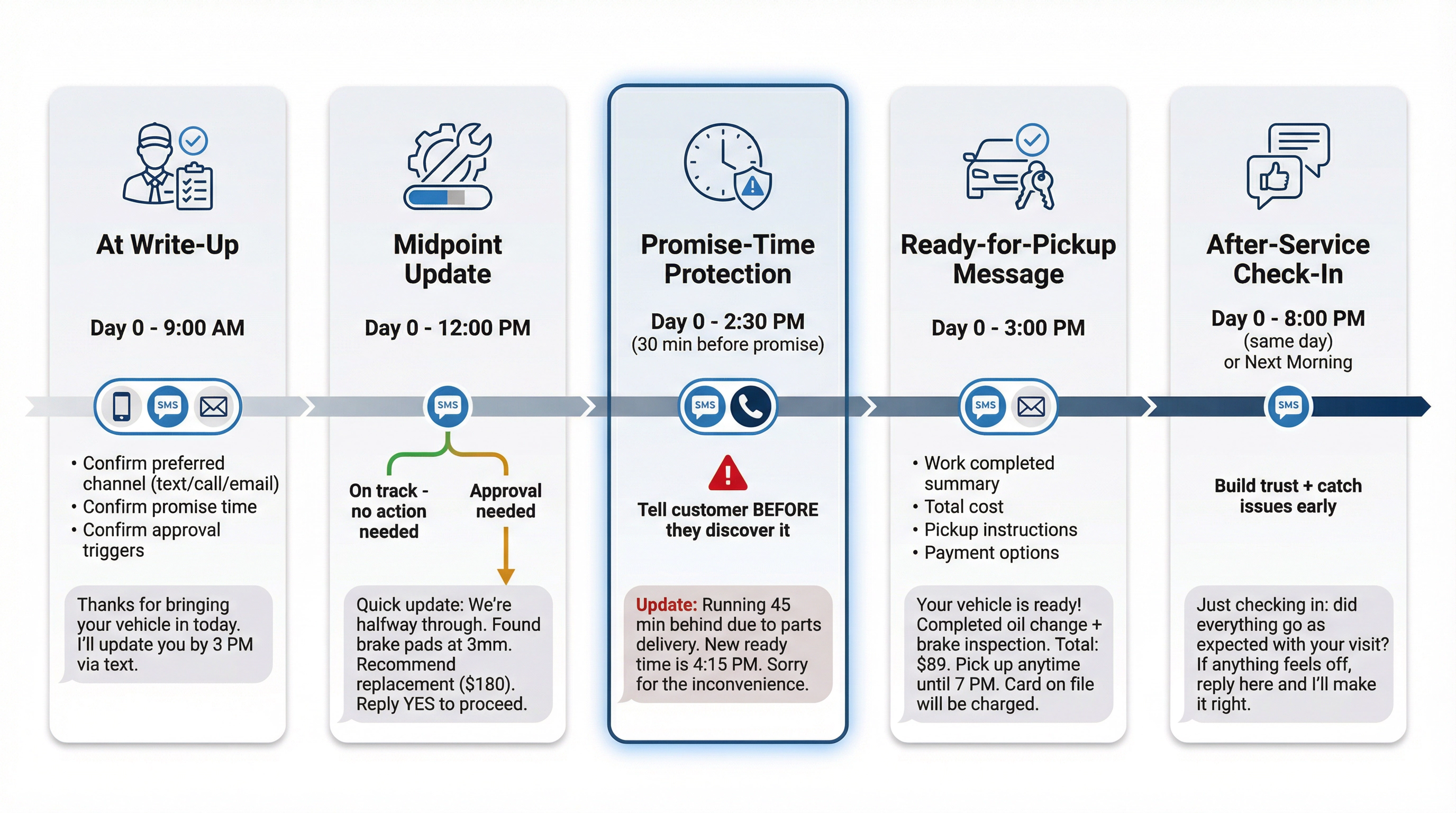
Minimum viable cadence (works for most stores):
- At write-up: Confirm customer’s preferred channel (text/call/email), confirm promise time, confirm what triggers an approval call
- Midpoint update: “Here’s where we are, here’s what’s next, no action needed (or approval needed)”
- Promise-time protection: If you’ll miss the promise time, tell them before they discover it
- Ready-for-pickup message: Include what was done, total, and pickup instructions
- After-service check-in: Short, human, same day or next day
This matters more than being “nice.” A friendly advisor with chaotic communication still gets crushed on surveys because uncertainty feels like disrespect for the customer’s time.
Service Update Templates You Can Copy and Customize
Write-up expectation text:
“Thanks for bringing your vehicle in today. I’ll update you by [time] via text. If anything changes before then, I’ll message you right away.”
Approval request text:
“Quick update: We found [issue]. Recommended fix is [repair]. Total is [$]. If we proceed now, you’ll still be ready by [time]. Reply YES to approve or ask any questions.”
Delay notification text:
“Update: We’re running about [X] minutes behind due to [reason]. New ready time is [time]. Sorry for the inconvenience. If that timing doesn’t work, tell me and I’ll help with options.”
Post-service check-in:
“Just checking in: did everything go as expected with your visit? If anything feels off, reply here and I’ll make it right.”
AI communication tools can automate this entire cadence across phone, SMS, and email, ensuring customers never have to chase for updates and your team never misses a follow-up.
How to Fix First-Time Repair Issues That Kill CSI
J.D. Power’s 2025 CSI Study found:
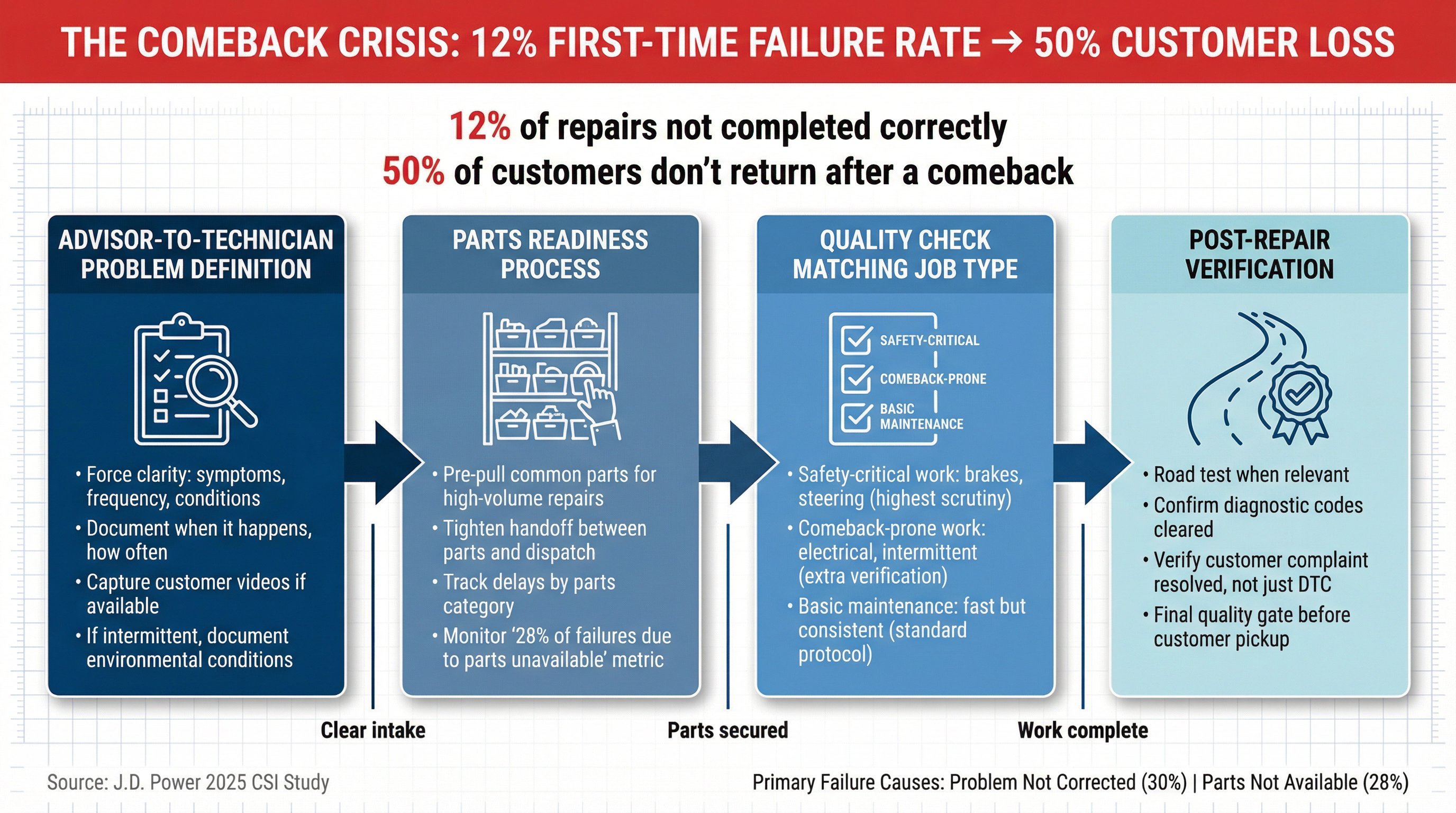
- 12% of repairs are not completed correctly on the first visit
- The most common reasons: work didn’t correct the problem (30%) and parts not available (28%)
- When repairs weren’t completed correctly the first time, only 50% of customers returned or planned to return
A comeback isn’t just rework cost. It’s a trust collapse. Customers often interpret “not fixed” as “they didn’t listen” or “they’re not competent,” even if the real issue was parts or diagnosis complexity.
4-Step Process to Reduce Comebacks
① Advisor-to-Technician Problem Definition
- Force clarity: symptoms, when it happens, how often, any videos from customer
- If the concern is intermittent, document conditions
② Parts Readiness Process
If parts availability is a top driver of “not fixed,” then:
- Pre-pull common parts for high-volume repairs
- Tighten the handoff between parts and dispatch
- Track delays by parts category
③ Quality Check That Matches Job Type
Different QC for:
- Safety-critical work (brakes, steering)
- Comeback-prone work (electrical, intermittent)
- Basic maintenance (fast but consistent)
④ Post-Repair Verification
- Road test when relevant
- Confirm codes cleared
- Confirm customer complaint is resolved, not just the DTC
How to Improve Sales CSI Scores
If your OEM separates Sales Satisfaction (SSI) from Service CSI, you still need the same principle: consistency beats charisma.
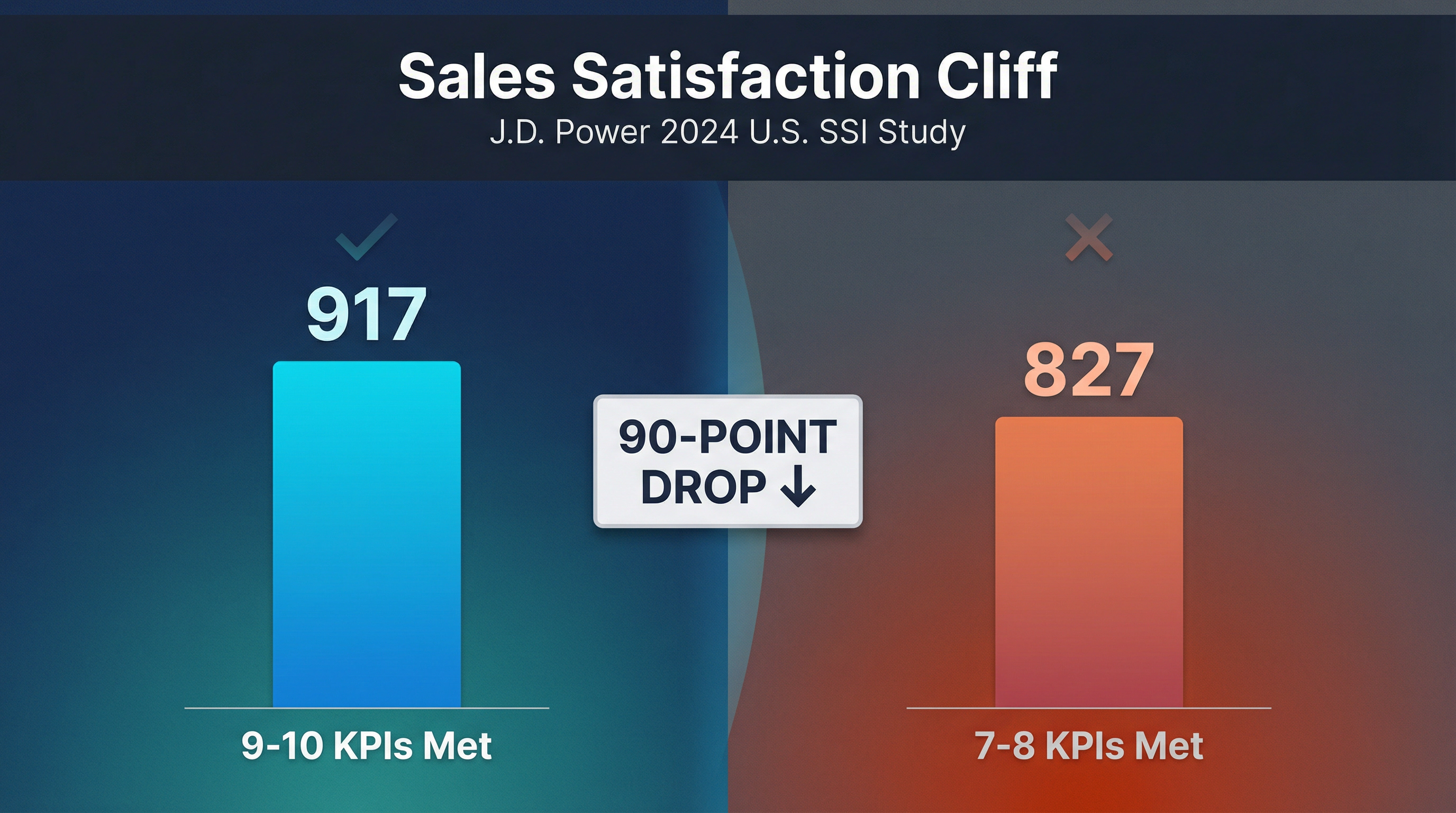
J.D. Power’s 2024 U.S. SSI Study shows just how sensitive satisfaction is to completing the basics:
- When buyers said 9 or 10 of 10 key KPIs were met, satisfaction averaged 917
- When buyers said only 7 or 8 were met, satisfaction averaged 827 (a 90-point drop)
Top KPIs include understanding customer needs, vehicle condition at delivery, and staff effectively using technology.
Sales CSI Improvements That Don’t Require Discounts
- Fast, consistent lead response (especially after-hours)
- Appointment-setting discipline (confirmations + reminders)
- Delivery that isn’t rushed: vehicle condition, feature explanation, next steps
AI-powered follow-up systems can handle sales outreach automatically via phone, SMS, and email, ensuring every lead gets consistent, timely touches that convert to showroom visits and test drives.
How to Train and Equip Your Team for Better CSI
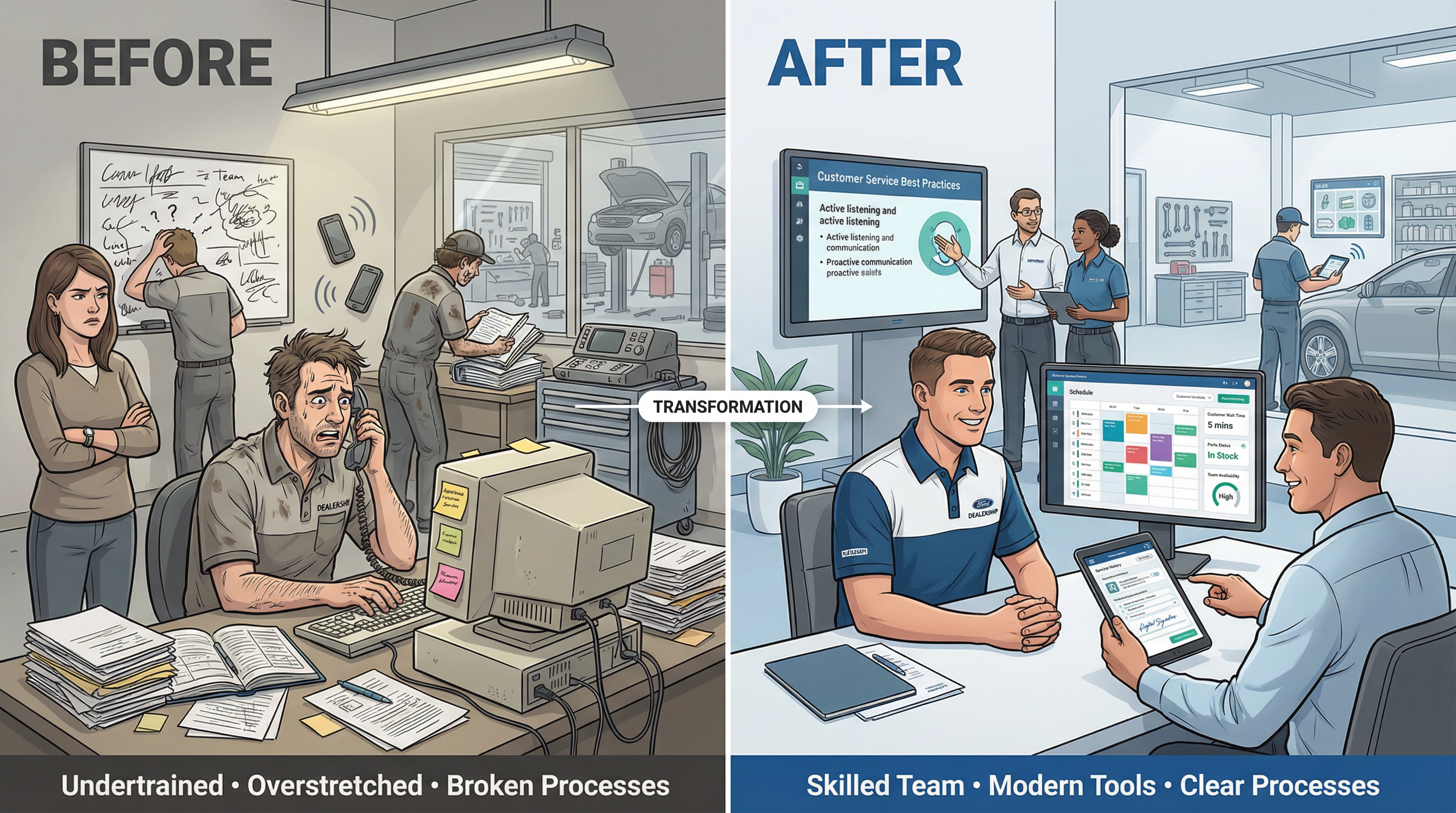
Behind every great customer experience is a great team. Behind many poor CSI scores are undertrained or overstretched employees and broken processes.
Training and Tools That Improve CSI
Train your staff early, often, and thoroughly on customer service skills and dealership processes, not just product knowledge. New salespeople and service advisors should be coached on everything from greeting customers to handling difficult situations. Schedule refreshers quarterly or whenever you spot a CSI issue that training can address.
Make sure your team has integrated software systems that put customer info, vehicle history, and appointment scheduling at their fingertips, plus communication tools (texting platforms, mobile tablets for write-ups) that allow faster updates. A connected system that lets advisors see real-time parts availability or automatically text status updates will prevent many customer frustrations.
How Employee Morale and Staffing Affect CSI
Happy employees create happy customers. If your team is overworked or underappreciated, it will reflect in their customer interactions. Focus on employee satisfaction: provide a positive work environment, recognize good performance, and solicit feedback on how to improve operations. Many top dealerships tie a portion of pay or bonus to CSI scores, but be careful. It should reward and motivate, not punish.
All the training in the world won’t help if your dealership is chronically understaffed during peak times. Look at your business volume and make sure you have enough advisors, techs, phone staff, and cashiers during rush periods.
How to Proactively Fix CSI Issues Before They Become Surveys
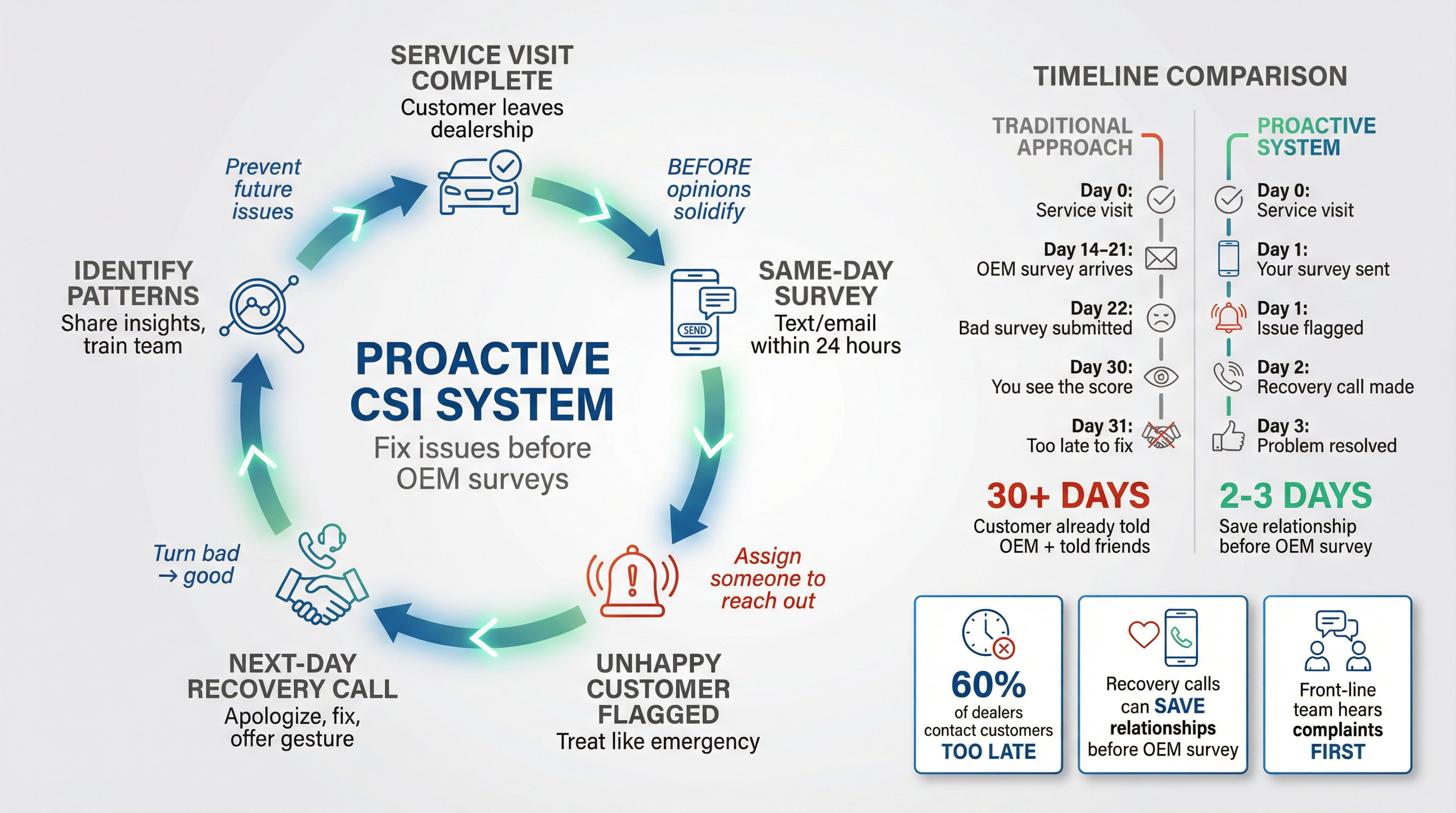
The best dealerships actively solicit feedback and address problems before they show up in CSI survey results or online reviews.
Set Up Your Own Rapid Feedback Loop
Don’t wait for the manufacturer’s CSI survey (which might come days or weeks later). Send a text or email survey the day after service asking if everything was satisfactory. This rapid feedback can alert you to unhappy customers while you still have time to make it right, potentially saving the relationship before the OEM survey is even submitted.
If a customer says they weren’t happy, treat it like an emergency. Reach out immediately with a sincere apology and an offer to resolve the issue. A free oil change for a long wait, or a complimentary detail after a comeback, can often recover a customer’s goodwill. Many successful dealerships make a “next-day recovery call” to any customer who gave a low score, turning around perceptions before the OEM survey arrives.
Mine Your CSI Data and Reviews for Patterns
Go deep into the CSI data the OEM provides. Look at which questions you’re scoring lowest in: “time to get an appointment,” “advisor courtesy,” “quality of work,” or something else. Share insights with your team (without pointing fingers) and brainstorm solutions together. Celebrate the areas where you score high to reinforce what’s working.
Public reviews on Google, Yelp, and Facebook are modern word-of-mouth. A cluster of reviews complaining about “service took too long” or “couldn’t get anyone on the phone” is a red flag that will echo in CSI scores too.
Get CSI Insights from Your Front-Line Team
Your front-line employees often know exactly what’s irking customers. Create a channel for them to share feedback upward, like a monthly meeting where advisors and reps can submit: “What problems are we causing for customers that we need to fix?” You might discover that your phone system drops calls or that customers hate a 3-hour finance process. When staff are involved in the solution, they’re more bought-in to delivering a great experience.
Your customers’ feedback is one of the most valuable resources your business can have. Gather it proactively and act on it quickly.
How to Run CSI Like a Process, Not a Panic
Most dealerships run CSI like this:
- Score drops
- Everyone freaks out
- Someone tells advisors to “ask for 10s”
- Score rebounds temporarily
- Then drops again
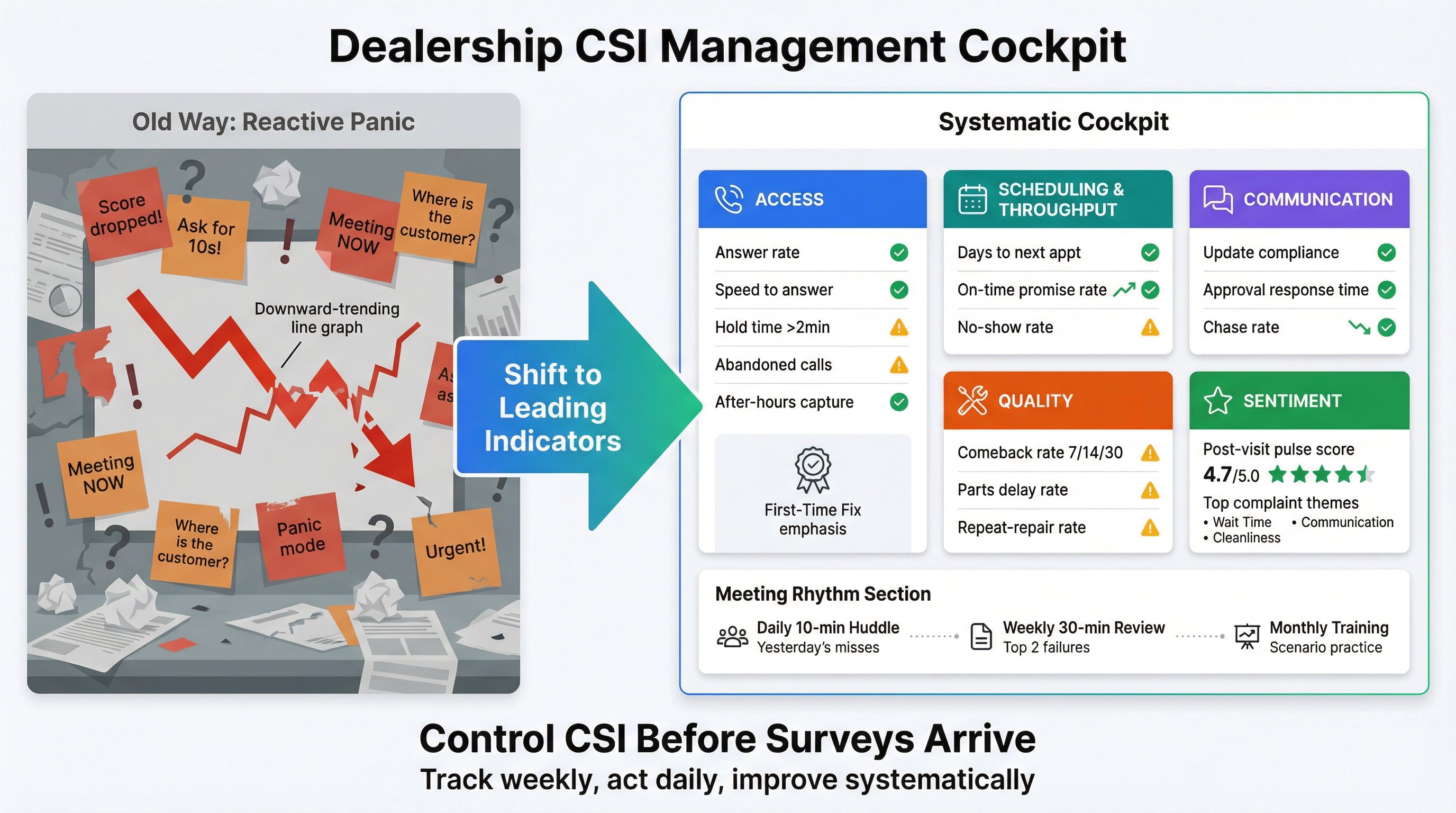
A durable system uses leading indicators so you can predict CSI before the survey arrives.
Leading Indicators Dashboard for Weekly CSI Tracking
Track these by department:
Access:
- Answer rate (service calls answered / total service calls)
- Average speed to answer
- Hold time distribution (especially longer than 2 minutes)
- Abandoned call rate
- After-hours capture rate
Scheduling and Throughput:
- Days to next available appointment (by service type)
- On-time promise rate (ready by promised time)
- No-show rate
Communication:
- Update compliance rate (did we send updates at the standard cadence?)
- Approval response time
- “Chase rate” (how often customers call for status)
Quality:
- Comeback rate (7/14/30 days)
- Parts delay rate
- Repeat-repair rate by category
Sentiment:
- Internal post-visit pulse (short SMS survey, separate from OEM)
- Top complaint themes
The point isn’t to create bureaucracy. The point is to create a cockpit.
Meetings That Actually Move CSI Scores
- Daily 10-minute huddle: Yesterday’s misses, today’s risk list (who is at risk of a bad experience today?)
- Weekly 30-minute root cause review: Pick the top 2 failure modes and assign fixes
- Monthly training: Roleplay the two hardest scenarios: delays and surprise approvals
90-Day Plan to Improve CSI Scores at Your Dealership
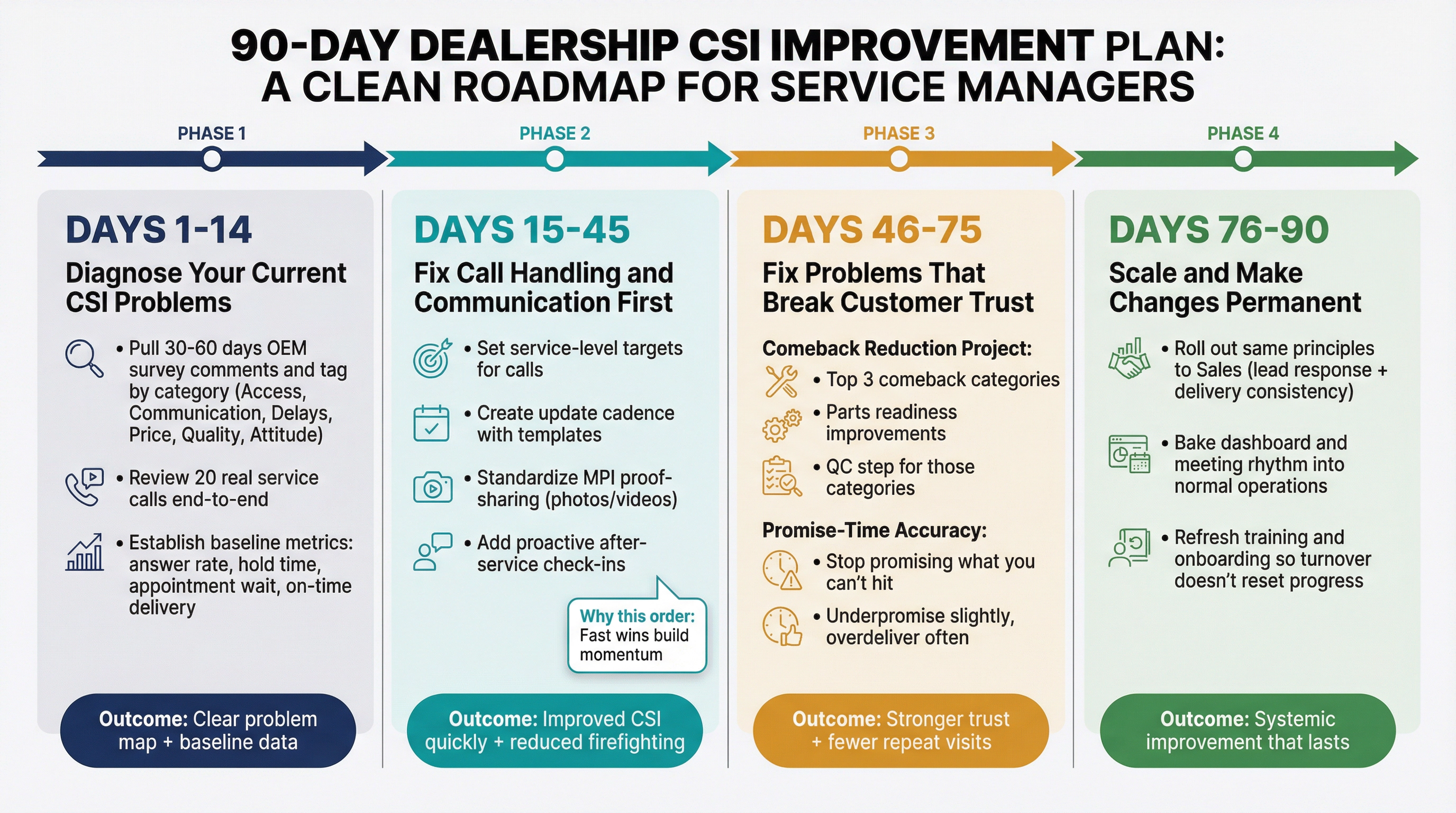
Days 1-14: Diagnose Your Current CSI Problems
- Pull the last 30-60 days of OEM survey comments and tag them:
- Access (phones/scheduling)
- Communication
- Delays
- Price surprises
- Not fixed
- Staff attitude
- Review 20 real service calls end-to-end
- Establish baseline metrics: answer rate, hold time, appointment wait, on-time delivery
Days 15-45: Fix Call Handling and Communication First
- Set up service-level targets for calls
- Create an update cadence with templates
- Standardize MPI proof-sharing (photos/videos)
- Add proactive after-service check-ins
Why this order: It improves CSI quickly and reduces firefighting.
Days 46-75: Fix Problems That Break Customer Trust
Comeback reduction project:
- Top 3 comeback categories
- Parts readiness improvements
- QC step for those categories
Promise-time accuracy:
- Stop promising what you can’t consistently hit
- Underpromise slightly, overdeliver often
Days 76-90: Scale and Make Changes Permanent
- Roll out the same principles to Sales (lead response + delivery consistency)
- Bake the dashboard and meeting rhythm into normal operations
- Refresh training and onboarding so turnover doesn’t reset progress
How AI Communications Can Improve Your CSI Scores

AI can be a legitimate CSI lever because it directly targets “access” and “communication,” two of the biggest drivers.

Evidence is emerging that customers are open to it. CDK reported in early 2025 that nearly 31% of surveyed customers prefer booking with an AI assistant, with higher preference for younger groups (44% for millennials and 51% for Gen Z).
Pied Piper’s 2025 study also observed that dealers with service scheduling AI could successfully handle 91% of calls without needing a human, and customers successfully scheduled an appointment 86% of the time at AI dealers (vs 90% at dealers without AI).
Why AI Handoffs Often Fail (and How to Avoid It)
Pied Piper also found that when AI couldn’t handle the request and attempted to transfer, those transfers were unsuccessful 56% of the time.
So if you deploy AI, your design goal isn’t just “answer calls.” It’s orchestrate the entire experience: warm transfers, callbacks with context, and clear next steps.
What to Look for in an AI Communications Solution
The best AI communications platforms don’t just answer calls and take messages. They handle the complete interaction:
- Answer every call instantly, 24/7 with natural-sounding AI voice agents
- Book appointments directly into your scheduler and DMS in real time
- Warm transfer to humans when needed, with full context
- Follow up automatically via SMS and email to re-engage leads and confirm appointments
- Run recall campaigns to bring customers back in
- Handle any language for diverse customer bases
Solutions built on custom voice infrastructure (rather than off-the-shelf components) tend to deliver smoother, more natural conversations. Deep integrations with schedulers, DMS, and CRM systems are critical. You want a platform that actually books appointments, not just collects information for someone else to handle later.
Case Study: Flai Results
Flai is our AI communications platform, live in dozens of dealerships and handling tens of thousands of calls. Our case studies show:
- Zero missed calls and zero hold times
- 88% conversion rate on bookable calls
- Monthly profit impacts of $80,000 to $100,000+ per dealership
We work with dealer groups including Findlay Auto Group and New Century Auto Group, and are backed by Y Combinator and First Round Capital.
Schedule a demo at www.useflai.com to see how AI communications can help your dealership.
Frequently Asked Questions
How quickly can I improve CSI scores?
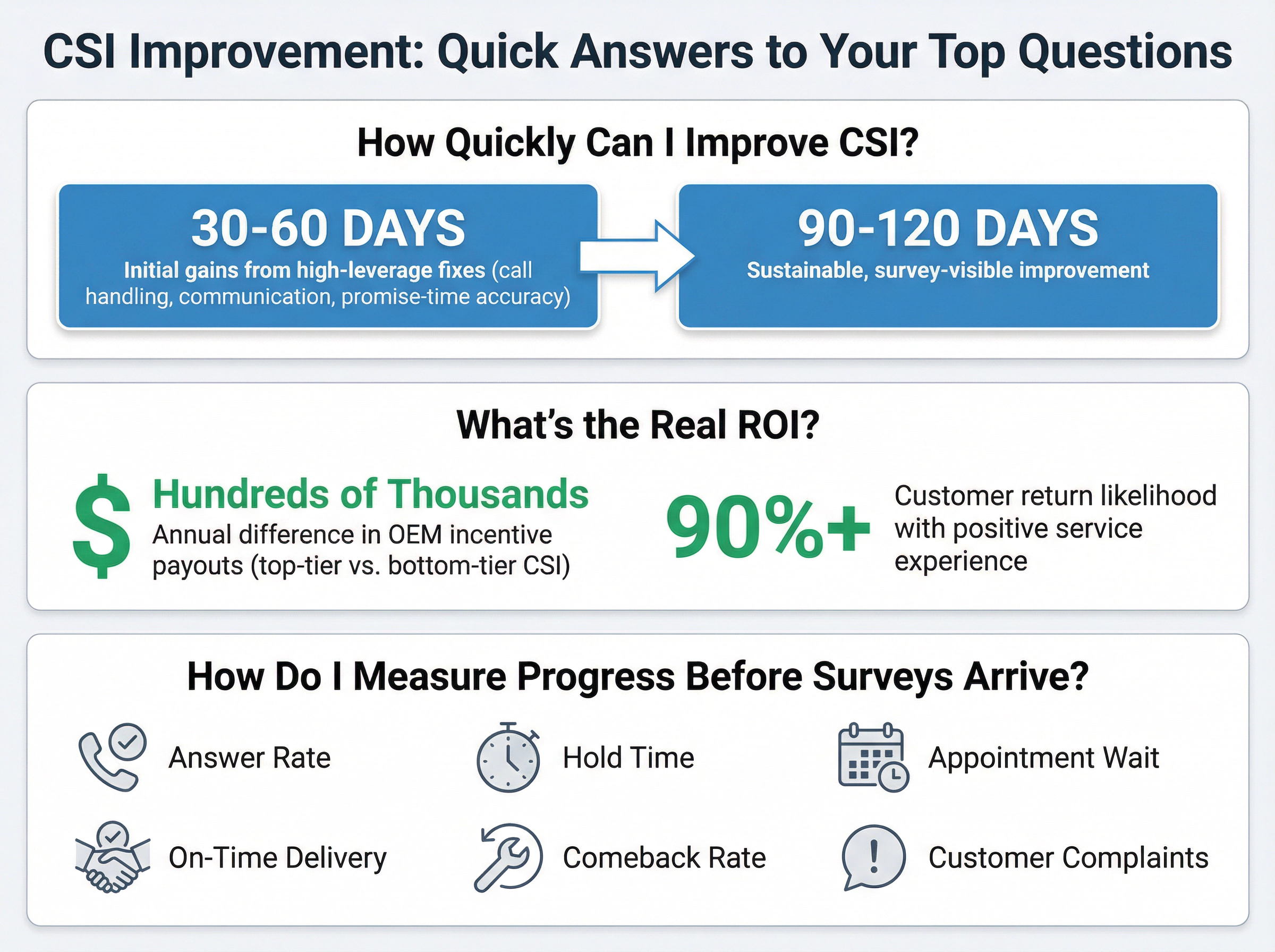
You can see improvements in 30-60 days if you focus on high-leverage fixes like call handling, communication cadence, and promise-time accuracy. But sustainable improvement (that shows up consistently in surveys) typically takes 90-120 days to fully set up and stabilize.
Do I need to replace my BDC with AI?
No. The best approach is often AI + human teamwork. Let AI handle high-volume, repetitive interactions (appointment scheduling, after-hours calls, basic FAQs, first-level triage), while your human team focuses on complex situations, relationship-building, and high-value conversations. This gives you 24/7 coverage without sacrificing the human touch where it matters most.
What’s the ROI on CSI improvements?
Top-tier CSI dealerships can receive hundreds of thousands more in OEM incentive payouts compared to bottom-tier stores. Plus, customers with positive service experiences are 90%+ more likely to return, increasing lifetime value. Even a modest CSI improvement can translate to six-figure annual gains.
Can CSI improvement work for small dealerships?
Absolutely. Many of the highest-leverage fixes (better call handling, consistent communication, fixed-right-first-time focus) don’t require massive budgets. Small dealerships often have an advantage because changes can be put in place faster without layers of approval. The key is systematic execution, not scale.
How do I measure progress before OEM surveys arrive?
Track leading indicators daily or weekly: answer rate, hold time, appointment wait time, on-time promise delivery, comeback rate, and customer complaints. Set up your own post-visit pulse survey (simple SMS: “How was your experience? 1-10”) to get immediate feedback you can act on.
Should I focus on service CSI or sales CSI first?
Service CSI typically has more immediate impact because service customers return regularly (more survey opportunities) and service profits are recurring. But if your sales CSI is critically low, address both simultaneously by applying the same principles (access, communication, consistency) to both departments.
Building a Customer-First Culture for High CSI
Improving CSI scores isn’t about chasing a number. It’s about building a culture and processes that consistently deliver excellent customer experiences. When you focus on the fundamentals (knowledgeable staff, prompt communication, quality service the first time, and continual improvement based on feedback), the score takes care of itself.
The payoff is huge:
- Loyal customers who return for future purchases and service
- Strong word-of-mouth in the community
- Substantial financial rewards from OEM incentive programs
Start with the strategies outlined above, involve your whole team, and track your progress. With a genuine commitment to customer satisfaction, you can turn CSI from a sore spot into a major strength.
If you’re ready to improve your dealership’s CSI with AI-powered communications that actually work, schedule a demo with Flai today. We’ll show you how we can help you capture every lead, eliminate hold times, and deliver the consistent, 24/7 customer experience that drives CSI scores up and keeps them there.